

The Hungarian Example
For years, American reactionaries have looked to Budapest as a model. Now maybe people who prefer democracy should do that too.
This week I was going to write a blog surveying the ways we can push back against American fascism, in answer to all those who justifiably continue to ask: “Beyond just bemoaning and lamenting, what can I do to help stop Trump?”
That piece is still on deck. But part of the answer begins with simple electoral politics. And when the stunning results of the Hungarian election became clear on April 12, they presented such an important case study on that front that it could not be mentioned only in passing, but demanded its own standalone essay. So as they say in Budapest: et voilà.
Be forewarned: I doubt I have much new to say on the topic that hasn’t already been said, but as is the longstanding policy of this blog, I’m gonna say it anyway. I’ll try to slip in something approaching some new insights near the end, for those with that kind of patience. (A man’s got to know his limitations.)
HUNGARY’S LAST TOP MODEL
For the past sixteen years, Viktor Orbán has been the very model of a modern autocrat to whom Trump and the Republican Party have looked, even more so than Putin, Erdoğan, or other title contenders. His autocratic makeover of Hungary was the explicit example the GOP wanted to emulate, to the point of fetishizing Orbánized Hungary, with its barely camouflaged neo-fascist government and retrograde culture war, raving about it endlessly on Fox News, and even holding editions of CPAC there five years in a row. (The man who ousted Orbán this month, Peter Magyar, has asserted that Orbán even used Hungarian treasury funds to pay for those conferences, though that claim has not been substantiated, yet.)
Over the years, Republican luminaries like Marco “Lil Marco/Big Shoes” Rubio, former White House Chief of Staff and presidential pardon recipient Mark Meadows, and post-Trump presidential hopeful Tucker Carlson made pilgrimages to Budapest to promote the Orbánist vision for the USA (with Tucker twice broadcasting his show to his millions of viewers from the Hungarian capital.) In 2024, in a video message at CPAC Hungary III (Electric Boogaloo), Steve Bannon called the country “an inspiration to the world.” The folks at the right-wing Claremont Review of Books are superfans, too, arguing that Orbán is “blessed with almost every political gift—brave, shrewd with his enemies and trustworthy with his friends, detail-oriented, hilarious.” And the love affair went both ways. In 2024 alone Orbán also made at least two visits to Mar-a-Lago to commune with Trump, and in 2022 spoke at that year’s flagship CPAC conference, in Dallas.
So why the mutual admiration society? It’s simple.
Orbán is often described as the first and/or most effective proponent of “illiberal democracy,” sometimes called “competitive authoritarianism” (although political scientists can quibble about the differences between the two). In their broad strokes, both terms describe a kind of soft autocracy—as opposed to outright totalitarianism—that maintains the veneer of participatory democracy atop what is really state control (of elections, of the media, of the judiciary, and so on). Often—as in Hungary, Turkey, the Philippines, or the US—that system is paired with a cult of personality. Putin runs that kind of show, too, though he is not averse to showing his claws when he’s cranky. But as astutely observed by The Atlantic‘s Anne Applebaum, Orbán “was the first person to do it from within a democracy and to do it while bragging about it.”
The key factor in an illiberal democracy is that there are still free elections, just ones that have been so perverted that opposition parties really have no chance of dislodging the ruling power. That part of the scam is not new—even the worst tyrants hold brazenly farcical elections, often winning 99.9% of the vote—only the sophistication with which it is executed. What distinguishes a modern illiberal democracy from old-fashioned jackbooted regimes is that the means of suppressing the opposition is better camouflaged and less ham-handed, offering semi-plausible cover for those inclined to give the regime the benefit of the doubt. Which the Republican Party has a habit of giving.
Applebaum—an expert both on autocracy and on Eastern Europe (and a part-time resident there, as her husband is a Polish politician)—neatly summarizes Big Vik’s “achievements”:
After being elected to a second term in 2010, Orbán slowly replaced civil servants with loyalists; used economic pressure and regulation to destroy the free press; robbed universities of their independence, and shut one of them down; politicized the court system; and repeatedly changed the constitution to give himself electoral advantages. During the coronavirus pandemic he gave himself emergency powers, which he has kept ever since. He has aligned himself openly with Russia and China, serving as a mouthpiece for Russian foreign policy at EU meetings and allowing opaque Chinese investments in his country.
Pointedly, Hungary remained a member of both the EU and NATO even as it functioned as an Arrested Development-style model home for modern fascism and a reliable surrogate for Moscow.
So how did Orbán and his party Fidesz (an acronym for Fiatal Demokraták Szövetsége, or Alliance of Young Democrats), pull that off? It wasn’t easy, but that’s precisely why the GOP held him in such high esteem. Here’s The Atlantic’s Zack Beauchamp in a piece titled “Make America Hungary Again,” published in July 2024:
In theory, Hungary should have been rocky soil for authoritarianism to flourish, given its decades-long, bitter experience with communism. But the reactionary spirit—the impulse to turn to authoritarianism as a means of staving off social change—remained a powerful lure for sectors of its society. Orbán skillfully manipulated this sentiment to build support for his political project and hid his assault on democracy behind subtle, legalistic maneuvering. He devised a playbook for paying lip service to democracy while hollowing out its institutions until an incumbent basically can’t lose. The Republican Party’s chorus of praise for this project is revealing, to say the least.
Orbán and his allies approached the project like lawyers—altering the Hungarian legal code in ways both bold and devious. Many of their tactics passed below the radar of all but the most attentive experts and activists. Over time, the combined weight of them made Fidesz extremely difficult to dislodge through electoral means.
Sound familiar?
One aspect of that effort was changes to how Hungarian elections were conducted, with what amounted to super-charged gerrymandering, and new rules that marginalized opposition parties, often buried in or attached to unrelated legislation. “Each was incremental, and potentially even defensible in isolation,” Beauchamp writes. “But in combination, the laws erected extraordinary barriers that would keep opposition parties from winning elections.” Kim Lane Scheppele, a Princeton professor who is an expert in Hungarian law, called it “autocratic legalism,” with laws that allowed Fidesz “to maintain a democratic veneer—and plausibly say that it’s standing up for freedom while actually restricting it.” Essential to that task, Beauchamp notes that Fidesz counted on the public to be bored and confused by the minutiae, and to tune them out until it was too late.
With the judiciary, Orbán forced judges into retirement and filled the hundreds of vacancies with his own toadies. He expanded the power of the constitutional court to rule in his favor and even created a whole new court system—one also stacked with Fidesz loyalists—to oversee election law and adjudicate corruption cases (or not). Leonard Leo would have doffed his toupee in respect.
Fidesz engaged in a similar process to bring public media under government control, firing independent reporters, and punishing dissenting voices. One of its chief techniques was simply to starve opposition (or neutral) media outlets of financing while underwriting friendly ones. A study at Central European University “found that, by 2017, roughly 90 percent of all media in Hungary was directly or indirectly controlled by the government, and the proportion has only grown since.” Here’s Applebaum and her colleague Hanna Rosin on that topic on the podcast Radio Atlantic:
Rosin: It wasn’t exactly like a takeover of the Hungarian media. It wasn’t literally controlling what people can and can’t see on the internet. A lot of it was more rich allies buying up media companies.
Applebaum: Absolutely, and the media is another area where I am 100 percent certain (the Republicans) are directly copying what Orbán did. They’re using their friends in business to buy up media—whether it’s CBS or whether it’s CNN—in order to shape it so that it’s more aligned with what the Trump administration wants it to be…
That control of the media came in handy when the Hungarian people did, on occasion, notice what Orbán’s was up to, forcing him to justify it with some time-tested gaslighting of a sort that might also sound familiar. Applebaum:
He told Hungarians they were under threat; they were in great danger. Initially, it was from immigrants, who were supposedly diluting the blood of the Hungarian nation. Later, it was from the degenerate gender policies of the West. And he created this idea that he was fighting against some kind of modernity.
Across the board, Orbán’s chutzpah was astonishing…and Orwellian. Speaking to CPAC Dallas in 2022, he argued that it was the left that used “liberal institutions, concepts, and language to disguise their Marxist and hegemonist plans.” Therefore, the right was justified in fighting back—as the saying goes—by any means necessary.
THE SINCEREST FORM OF FLATTERY
The appeal of Orbán’s Hungary to American right-wingers is obvious. Even before Trump re-took the White House, Beauchamp observed:
Trump’s admiration for autocrats is no secret, but Orbán represents something particularly insidious. Hungary has become an authoritarian beachhead in the heart of Europe by custom-building its quasi-dictatorship to survive and even thrive in a place where most people believe in democracy. Orbán has created a system that can pull the wool over his citizens’ eyes, making them feel as though they have power over the state even as the state exerts power over them.
Orbán’s autocratic legalism is designed to create the appearance of democracy, supplying plausible deniability to the project of democratic dismantlement. This is the playbook to watch for when Donald Trump, Ron DeSantis, and many other prominent Republicans cite Hungary as a “model.”
But the Republicans didn’t just fanboy; they slavishly imitated. Orbán, The Atlantic’s Jacob Heilbrunn wrote way back in 2022, “made Hungary a laboratory for the conversion of a liberal democracy into an authoritarian state,” and that, Applebaum notes, “is precisely what Bannon, (Heritage Foundation president Kevin) Roberts, and others admire, and are indeed seeking to carry out in the US right now.”
As Applebaum told Rosin, Orbán “was an open source of ideas for the illiberal and even autocratic part of the American MAGA movement.” Indeed, “many aspects of what the second Trump administration did were copied from the Hungarians.”
(T)he most obvious one is the takeover of the bureaucracy, the firing of state employees, the conversion of state employees from neutral people who are promoted based on merit to party hacks, which is part of what Trump and his people are trying to do, most obviously in the Justice Department and the FBI, but in all branches of government. This was a direct copy of what Orbán did.
Project 2025, of which the Heritage Foundation’s Roberts was a chief architect, was chock-a-bock with ideas lifted directly from the Hungarian model. The attack on the federal bureaucracy and civil service system—that is to say, the replacement of 50,000 federal bureaucrats with Trump-aligned ideologues, as Beauchamp describes it—is another campaign laid out in that blueprint, and with explicitly Orbánist inspiration. The destruction of the Corporation for Public Broadcasting, whose budget Heritage fellow Mike Gonzalez described as “half a billion dollars squandered on leftist opinion each year,” and which was also specifically laid out in Project 2025, was another direct lift from the Orbán playbook. The same with the scheme to install Trump loyalists atop “every office and component across the department—especially in the Civil Rights Division, the FBI, and the Executive Office for Immigration Review.”
To grasp just how closely the American fascist movement mimicked Orbán, observe how Rosin starts the story on her podcast:
The leader of a democracy overpowers many of the country’s institutions that could oppose him: the media, the universities, the courts. He encourages rich allies to buy big media companies and hobble independent journalism. In its place, he tells the population lies, about immigrants, the economy, and who their real enemies are. He does all of this openly and proudly, prompting other aspiring autocrats to emulate him.
Get it?
Not long ago, observers like Beauchamp and Applebaum were pretty pessimistic, both about the prospects for the return of democracy in Hungary, and about the chances that the United States could resist going down that same dark path. And in both cases, the regime’s ability to prevent electoral defeat was the crux of the dilemma.
Here’s Beauchamp, again writing in the summer of ‘24: “Today Hungary is in the grips of a near-perfect system of subtle authoritarianism. Elections do not need to be nakedly rigged, in the sense of falsifying vote counts, because the deck is so stacked against the opposition that winning is functionally impossible.” As proof, he reports that in the 2022 elections, even when the opposition parties united on a single ticket, with carefully selected candidates, that anti-Fidesz coalition was crushed, because it was “(f)inancially hobbled, fighting on a gerrymandered map, and unable to get its message out because of government control of the press.”
A year later, in the spring of 2025, when Trump was early in his second term and he and his flying monkeys were especially emboldened, Applebaum wrote a piece for The Atlantic called “America’s Future is Hungary.” Published as it was pretty much at the height of Trump’s initial blitzkrieg against everything decent and good and functioning in America, that assessment, too, was fairly glum:
As Elon Musk, a government contractor, sets fire to our civil service and makes decisions about the departments that regulate him; as the FBI and the Justice Department are captured by partisans who will never prosecute their colleagues for corruption; as inspectors general are fired and rules about conflicts of interest are ignored, America is spinning quickly in the direction of Hungarian populism, Hungarian politics, and Hungarian justice. But that means Hungarian stagnation, Hungarian corruption, and Hungarian poverty lie in our future too.
But almost accidentally, Applebaum also offered what turned out to be an optimistic vision of what would soon happen to Orbán—and maybe now, is happening to Trump as well—in that her description of his corruption predicted what would bring him down.
That corruption had a terribly damaging effect on the broader Hungarian economy. As Applebaum explains it, about 20% percent of Hungary’s companies were operating not on market principles, but on loyalty to the despot, companies “designed not for efficiency and profit but for kleptocracy—passing money from the state to their owners.”
“But the truth is not hard to perceive for anyone who cares to look, because the beneficiaries of this corrupt system are not shy about showing off their wealth.” (Pointedly, this crony capitalism on Orbán’s part also featured naked nepotism, such as favoring an energy company co-owned by his son-in-law Jared Kushner—er, I mean István Tiborcz.)
And the Hungarian people did take note.
Orbán’s opponent Peter Magyar ran a kitchen sink campaign about the economy, health care, education, and fighting that sort of corruption. Orbán, by contrast, ran a demagogic one centered on fearmongering and the laughable notion that a cocaine-crazed Volodymyr Zelenskyy was going to attack Hungary. Apropos of Ukraine, the Hungarian public’s awareness of Orbán’s coziness with Moscow also hurt him. (Wouldn’t it be something if the American public had that same response to Trump’s?) Hungary also had a stalwart resistance movement that never lost faith, as depicted in Connie Field’s acclaimed 2024 documentary Democracy Noir.
As the economy faltered and the corruption within the Orbán regime became glaringly obvious, the opposition gained strength. The New Yorker’s Andrew Marantz observed:
Business élites started to signal dissatisfaction with Orbán. Whistle-blowers emerged from the military and the police. Orbán’s grip on power, unquestionable for a decade and a half, suddenly looked vulnerable. (Even he seemed to know it: at a joint press conference with Vice-President J.D. Vance, who’d come to Hungary to stump for him, Vance said, “Viktor Orbán is going to win the next election,” and Orbán made a tentative so-so hand gesture that immediately became a meme.)
Another parallel: it was reported that the Russian security services (specifically, the SVR) proposed faking an assassination attempt on Orbán to boost his “heroic” image and help him in the race. Hmmm.
THE GREAT PSYCH-OUT
One of the most remarkable takeaways from Magyar’s surprising victory, as Applebaum and Rosin point out, is that it was a stark defeat for propaganda, which aims to make an oppressed population feel helpless, and create the illusion that the ruling junta cannot be beaten, so why try?
Like Trump, Orbán dealt in what Applebaum calls “post-reality,” which is a fancy way of saying disinformation, lies, and other bullshit. In The New Yorker, Marantz reported that even on the eve of the election, dozens of Hungarians, some of them highly informed (even professionally so), told him that they could not imagine Orbán losing, even though all objective signs pointed to that outcome. (Like Democrats in the US, they had been burned before in prior elections when rising hopes were dashed. Déjà vu all over again.) These folks, Marantz reports, were worried that even if Orbán lost, there would be “some sort of legal trickery, or last-minute intervention by the Russians,” or simple violence. “The only scenario that seemed impossible to contemplate was a clear win for Magyar, a quick concession from Orbán, and a moment of national catharsis.”
But that’s precisely what happened.
In this election, Orbán found his usual gaslighting a tougher row to hoe, particularly with the hard-to-sell fantasy that Ukraine was a belligerent threat menacing the Hungarian nation, even after going to such lengths as deploying Hungarian soldiers to guard power stations against an entirely mythical Ukrainian attack. And the same may prove true for Trump, with his disastrous war on Iran and an economy in freefall, both things that are very hard to hide (and which, of course, are connected: check the prices at your local pump). Not to mention the looming specter of Epstein and his own increasingly self-evident mental decline.
Last year, the Hungarian political philosopher Zoltán Miklósi had warned Marantz about the kind of defeatism that suggests that “once authoritarianism takes hold, there’s no way out.” “It’s understandable,” Miklósi said, “after so many years of setbacks and humiliations, but it’s one of the biggest dangers, because it deprives you of political agency. Defeatism breeds defeat.” Marantz went on to quote Miklósi, writing in a recent piece for the American Journal of Political Science called “Perversity, Futility, Complicity: Should Democrats Participate in Autocratic Elections?”
The outcome of autocratic elections, despite the immense advantages of the ruling party, is not entirely predetermined. Electoral autocracies are unique among autocracies in that their ruling party can, though rarely, be defeated by an opposition that plays within the autocrat’s own formal rules of the game.
And Hungary is no outlier, only the latest example. A little over two years ago, I wrote an essay for this blog called “The Guatemalan Model,” about the triumph of an unlikely pro-democracy movement in that country, which had been under the heel of a brutal, kleptocratic right-wing regime for 27 long years. As I wrote at the time, one of the key things that Guatemala’s pro-democracy movement did was not “give in to a feeling of powerlessness, resignation, or despair. And perhaps above all, it did not surrender to its enemies’ self-serving and deceptive presentation of themselves as invincible.”
(After the Guatemalan Model and the Hungarian Example, next up we have the Irish Backstop, which contrary to popular belief, is not a sex act involving a pint of Guinness and an enema. And the less said about the Croatian Somersault, the better.)
The point is, autocrats want you to feel helpless, as they prefer a populace that feels resigned to its fate and doesn’t resist at all, rather than one they have to actively beat at the polls. It’s within power to show them otherwise, just as the good people of Hungary and Guatemala did.
THE BOY WHO CRIED “RIGGED!”
It’s early days yet, and there are lots of obstacles ahead. Applebaum predicts that this retreat by Viktor (doesn’t he have to stop using that name?) may be merely a strategic withdrawal, as he and his allies look for another way to return to power. For one thing, Orbán and Fidesz still control Hungary’s judiciary and its intelligence services, which presents an institutional problem for Magyar’s new government, just as was the case in Poland after the right wing Law and Justice Party (PiS) was finally ousted in 2023, and is ongoing in Guatemala even now.
I am also slightly skeptical of Magyar himself, who was a loyal member of Fidesz until recently reinventing himself. (Orbán himself had started out as a reformer candidate after the fall of the communist regime in 1989.) Marantz writes that Magyar “ran as a Hungarian Everyman, dodging divisive policy questions and preferring to speak about the most universal issues in the broadest possible terms: rooting out corruption, restoring power to the people.”
This was, of course, an astute political strategy. It also makes him something of a cipher. He has the square jaw and coiffed blond hair of an action figure. Magyar, in Hungarian, means “Hungarian.” (Imagine a strapping guy named Joe America, running as the nominee of the Freedom and Grilled-Meat Party, and you won’t be too far off.)
During the campaign Magyar even attacked Orbán from the right on some issues, including immigration, claiming, for instance, that Filipino immigrants to Hungary were stealing and eating ducks and goldfish from a zoo. (In the UK, Nigel Farage has made that claim about immigrants and swans, while in the 2024 US presidential race JD Vance alleged that Haitian immigrants were stealing and eating geese and ducks from local parks in Springfield, Ohio, part of his more famous lie that they were “eating the cats and dogs,” which his boss picked up.)
So Magyar may yet turn out to be a Fetterman. But even if he does, that does not in any way detract from the fact that a pro-democracy candidate—or at least one who appeared that way—was able to oust one of the most legendary strongmen in the whole of Europe. If Donald Trump is sleeping at all these days, that fact should scare him out of his Depends, and take away whatever few minutes he’s able to rest at all.
And though it may not always feel like it, our beleaguered democracy is in better shape than Hungary’s was. (Rosin’s podcast episode is called “If Hungary Can Do It,” which is what I would have called this piece if I’d thought of it first.) In the US over the past year, we have seen one special election after another won by Democrats, often in deep red districts. Just last week, voters in Virginia backed an unapologetically partisan ballot measure involving redistricting that will likely give Democrats up to four more seats in the US House, a tit-for-tat counterattack after Texas Republicans started this gerrymandering arms race. (Even though a Republican judge, who is totally not one of those activist judges that conservatives hate hate hate, immediately overturned the vote. Virginia’s Democratic AG is appealing.)
OK, you say, but won’t Trump still declare any election he or his party loses as fraudulent by definition, as he did (with even less cause than usual, which is to say, less than zero) with that ballot measure in Virginia last week, before that friendly judge came to his aid? Yes, certainly: it has long been clear that Trump will do that. In The Bulwark, Andrew Egger writes:
What Trump and his allies have created over the years is a self-sustaining and self-reinforcing base of electoral nihilists. In past cycles, convincing such people that the fix was in usually required the mass propagation of specific lies: rigged voting machines from Venezuela, 2,000 Mules-style ballot-stuffing operations, batches of phony ballots snuck into the count by dastardly poll workers. But now this crowd’s cynicism has achieved orbital velocity; it no longer requires additional thrust. When Trump points at any given election and shouts “rigged!”, he no longer needs anything resembling a smoking gun: A giant chunk of the electorate is ready to go along.
But the majority will not go along, and that drains his ruse of its power. In other words, Trump’s clockwork reliability is producing diminishing returns and starting to be self-sabotaging thanks to that exact predictability. That is an advantage for our side, as it pre-emptively prepares the American people (the thinking segment of it, anyway) to disregard his claims.
What’s all the more remarkable is that Orbán—supposedly a more nakedly authoritarian than Trump—did not challenge his electoral defeat, but quickly conceded. Applebaum cops to being “extremely surprised” that he went without a fight:
Even on the day of the voting, people around Orbán in the government were warning of terrorism. They were talking about threats. They were talking about violence. They were talking about the election being stolen. They were preparing verbally, and in terms of propaganda, to announce that the election was false or would be falsified.
People were ready for all kinds of different outcomes—that the election would be challenged—and there were lawyers who were prepared for that. Just like in the US, people were prepared for a challenge, and they were prepared to fight it.
Don’t quote me, but it just may be that knowing his foes were going to fight back is part of what dissuaded Orbán and his allies from trying to claim that the vote was rigged. The other factor that made it hard for him to do that was the sheer numerical size of Magyar’s victory.
So maybe voting does matter after all. Who knew?
IT CAN HAPPEN HERE (GOES BOTH WAYS)
So here is the big takeaway from the Hungarian election: one of the most deeply entrenched and high profile autocrats in the entire developed world, the very man American right-wingers revere like a demigod and to whom they have long looked for example and guidance, got kicked out of power by his own people, with a vengeance, and by normal electoral means no less. The margin was so big, and his defeat so obvious, that even his formidable propaganda machine could not spin it, and he did not dare question the vote. And like Joe Frazier in Kingston in 1973, down he went.
Other tyrants who seemed invincible have been similarly overthrown, from Marcos to Duvalier to Honecker and more. Marantz one last time:
Even under competitive authoritarianism, politics is still politics. Viktor Orbán was a politician—a ruthless, cunning one, unusually capable of bending and breaking the rules of liberal democracy—but not, in the end, an invincible superhero. He did what he could to lock in his power, but he couldn’t manufacture popular support simply by willing it into existence. (Neither, it’s worth reminding ourselves, can Donald Trump.)
I genuinely believe that overreach, greed, corruption, and incompetence always bring these bastards down, and maybe that happens faster in the US, on both ends. Like Trump, Orbán had two distinct turns in power—1998-2002 and 2010-26—separated by a spell in the wilderness during which he nurtured his grievances and honed his method. It was really in the second go-round that he carried out his autocratic project. It took Orbán about a decade to consolidate power and 16 years to fall. Trump made the US into an autocracy in nine months, and has stumbled just as quickly. After starting with a vengeance in the early months of his second term, the wheels are now visibly coming off the Trump train. Not to get out too far over my skis, as they say, but I am beginning to be guardedly hopeful that 2025 and early 2026 will prove to be the peak of Trumpian madness—which is to say, the low point for us on the side of democracy—and that we now have momentum on our side.
So going forward, let us remember that this was not the “fall” of Orbán , as some would have it. He was PUSHED, by his own people. And we can do the same to our own monstrous, tinpot would-be dictator.
*******
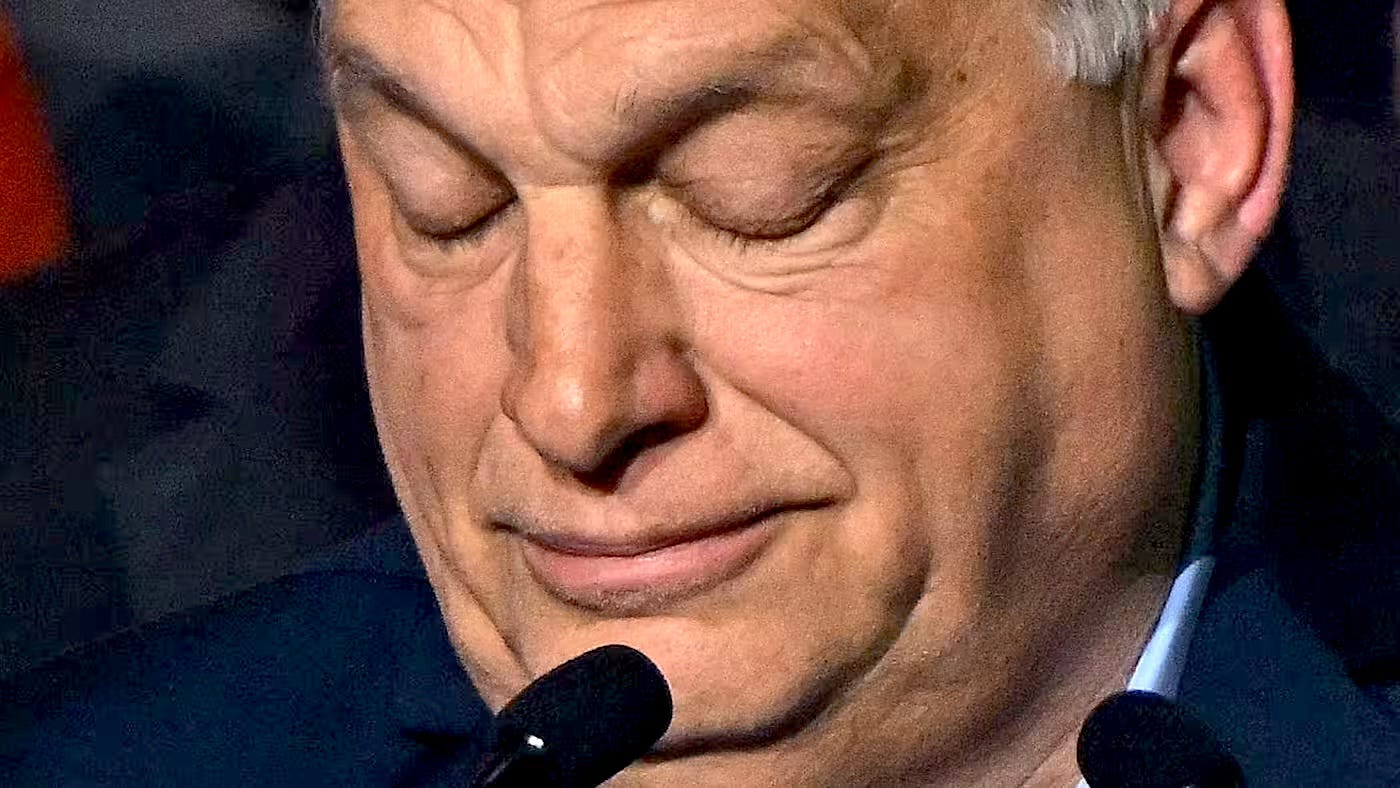
Photo: Another big fat loser. Credit: Attila Kisbenedek/AFP/Getty Images.
I appreciate your writing - thanks!
Read where the Hungarian oligarchs are fleeing to the US with their $$ hoping to avoid arrests and retribution. Trump will try to shield them.