

Remembering Bill Jersey
The passing of a most remarkable man.
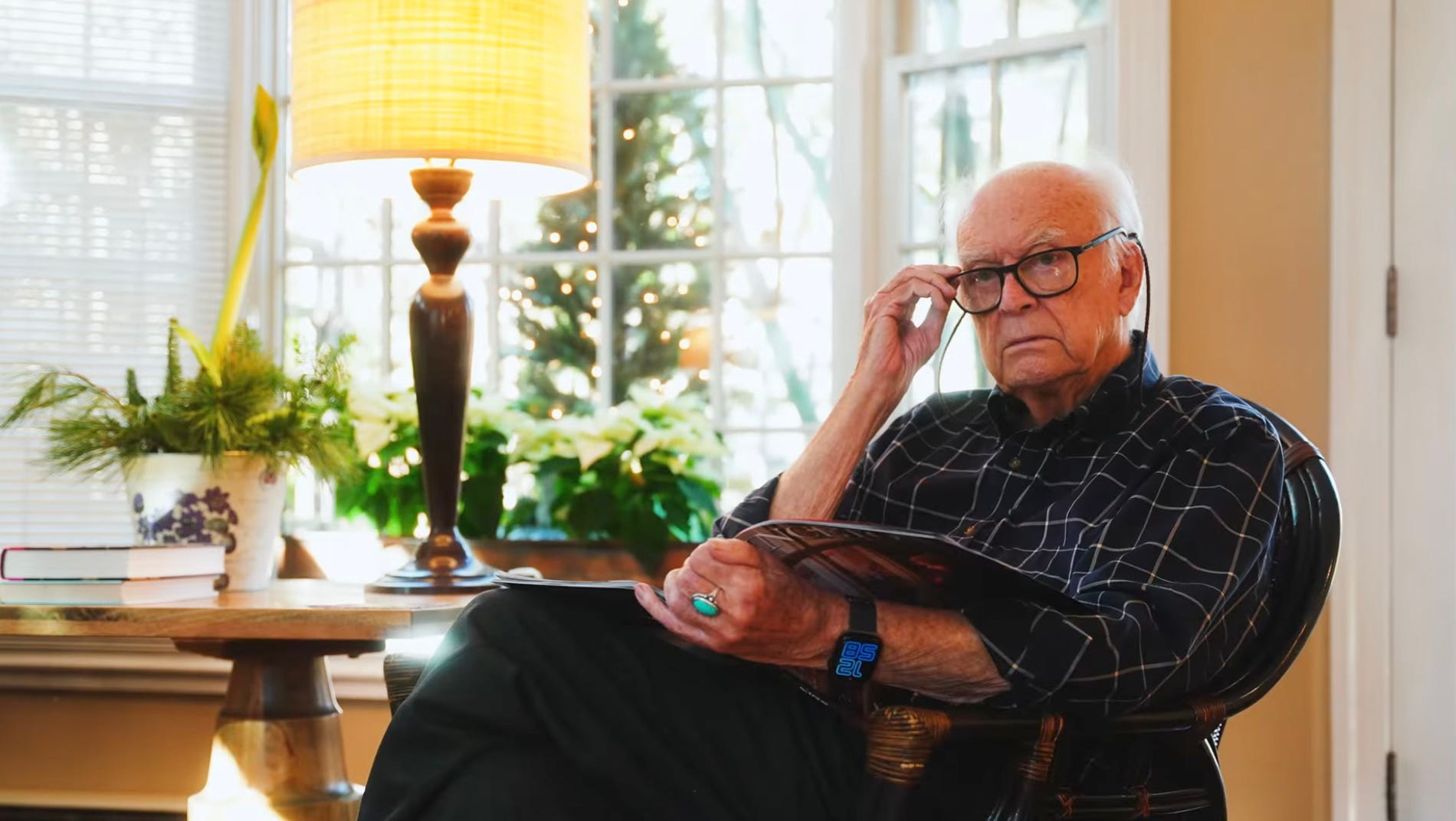
On Friday July 24, my dear friend of thirty years Bill Jersey passed away at the age of 99.
Bill—who was one of the first people who hired me, right out of film school—was a mentor to me and my wife Ferne and so many other documentary filmmakers, on both coasts. As one of the pioneers of the cinema verité movement in the early 1960s, Bill made dozens of films over seven decades, won the duPont-Columbia Award, two Peabodies, two Emmys, and the Gold Medal for his body of work from the National Arts Club in New York City, among many other honors. He also earned two Oscar nominations, including one for A Time for Burning, his searing 1966 study of a Lutheran church in Nebraska wrenched over racial integration, which has found a disturbing new relevance in the Trump era. That film—shot on 16mm black & white film in the fly-on-the-wall style that Bill shared with other verité innovators like Fred Wiseman, the Maysles, and Canada’s NFB—remains such a stunning portrait of deeply ingrained racism in America that Richard Brody of the New Yorker wrote an entire piece about it as recently as 2022 (and kindly linked to my interviews with Bill in these pages). In 2020, the Academy of Motion Picture Arts and Sciences created a new master of them film; you can see the full documentary online here.
Operating out of the famous Fantasy building in Berkeley, Bill and his company Quest Productions were a mainstay of the Bay Area documentary community for decades. (His non-profit Catticus Corporation was also the fiscal sponsor for untold numbers of documentaries.) Bill’s work also includes Super Chief: The Life and Legacy of Earl Warren, which was also nominated for a Best Feature Documentary Oscar; Loyalty & Betrayal: The Story of the American Mob and Children of Violence, which both won Emmys; The Glory and the Power (about religious fundamentalism); Faces of the Enemy (on the uses of wartime propaganda, with Jeffrey Friedman); and Renaissance (a four-part series on the history of the Renaissance), all of which were nominated for Emmys; and The Rise and Fall of Jim Crow, a four-part series which won a Peabody. His final run of documentaries included Eames: The Architect & The Painter (about Charles and Ray Eames), which also won a Peabody, and American Reds (a history of the American Communist Party, with Richard Wormser).
Over the course of his long career, Bill was strongly identified with that sort of deeply humanistic, politically progressive, Berkeley-based brand of social justice filmmaking. But he was raised in—as he calls it—a “Bible-believing” fundamentalist Christian family in Queens, which gave him a unique frame of reference on the bizarre state of affairs in which America now finds itself.
Bill was not an easy guy, especially around the time I met him, when he was already in his 70s. On my first day as a very young editor working with him in the edit bay, he tested me, barking at me for offering my input on a given cut. (I think his exact words, drill sergeant-like, were: “If I wanted your opinion, I’d ask for it!” He warmed up after I replied, “Well, if all you want is a button-pusher, you’re overpaying me.”) Another time, when I was filling in doing sound for him—not my main gig—while he was shooting in the GM/Toyota NUMMI factory in Fremont, he (verbally) beat the shit out of me for getting the mike in the frame and not being where I should have been, like a pro soundman like John Haptas or Doug Dunderdale. But he wasn’t wrong.
One of the invaluable things Bill taught me was how to “direct” a documentary interview: that is to say, how you can coax, manipulate, and otherwise guide the interviewee—draw them out if they’re shy, or cool them down if they’re being too cute, or settle them if they’re anxious—with your own tone and body language, irrespective of the actual content of the questions. I never forgot that.
Bill and I grew even closer after he semi-retired from filmmaking and moved back east, settling in bucolic (and hip) Lambertville, NJ, where he devoted himself to his first love, painting, which he studied as an undergrad at Wheaton College in the 1950s. (His work is quite beautiful, as one might expect from a cinematographer. Check it out here. You can hear Bill discussing it eloquently in this interview from 2022.) Coincidentally, Lambertville is about ten seconds across the Delaware River from where my parents had long lived in New Hope, PA, so Ferne and I saw Bill and his wife and partner Shirley Kessler frequently on our visits there.
A few months ago I was in town and went to see Bill and Shirley for what I knew might be one of our last visits…though I had thought that several times, and yet Bill kept giving the Grim Reaper the middle finger. But this visit, for the first time, Bill’s memory had begun to go, and initially he didn’t know who I was when I arrived. Then Shirley got a phone call and had to go into the other room, and when she did, Bill and I sat there talking. Slowly, he came completely back to the way he was, like a switch had been flipped. We sat talking exactly as we would have done 30 years ago. He was as sharp as ever: up to date on current events, politics, film, culture, the state of our embattled democracy, and spoke about all of it with the insight and wisdom that we’d all come to expect from him.
We talked for at least an hour, and then, as quickly as it came, his memory slipped away again.
That was the last time I saw him.
I interviewed Bill for this blog twice—a long two-parter in its earliest years about Trump and the end of evangelicalism, called “Jesus Wept” and “Truth or Consequences,” and then again in 2020, in an essay about racial reckoning in the wake of George Floyd’s murder, called “America Against Itself: A Time for Burning (Again).” Excerpts from those interviews are below.
Bill Jersey was a complicated man, a passionate man, a brilliant man, a generous teacher, a stalwart friend, and a true artist, and I owe him more than I can say. He will be missed. When comes such another?
UNEXPECTED PULPITS
From “Jesus Wept” (January 2018):
THE KING’S NECKTIE: What were the core religious beliefs that you were raised in, as part of a fundamentalist family?
BILL JERSEY: “Jesus said it, I believe it, that settles it.” That’s what I grew up learning. We used to say, “If the King James version was good enough for Jesus, it’s good enough for us.”
TKN: Right, that’s the old joke. “If English was good enough for Jesus.” But did the things you were taught in school growing up conflict with the church?
BJ: I’m sure in terms of evolution they did, but I don’t even remember it. I bought a little Kodak Brownie box camera and I would go to dances and I would take pictures and sell my classmates pictures of themselves. So that got me a little money, and got me to be a part of dances that I wasn’t allowed to go to. Even in the Navy, when I was 18, I had a wonderful Jewish friend and he said to me, “Jersey, we’re going out to see some strippers. Why don’t you join us?” I said, “I can’t do that!”
TKN: So when did your discomfort with fundamentalism begin?
BJ: I was always uncomfortable with being told that if I didn’t save you, you were going to hell. That made me responsible for you going to hell. Now that’s a pisser, man. That is a burden you don’t easily dismiss. So I carried that weight.
As a teenager, I would go into New York City with my packet of biblical tracts explaining how you needed to be saved, and I would pass them out dutifully, but somehow, I just wasn’t sure I was better than the guy I was giving the tract to, or that what it was saying was better than what he might have said if I had asked him. So there’s always that lingering doubt.
Fortunately, I did meet some really wonderful Christians, not because of their churches but in spite of them, and because of their real faith. Because instead of listening to what their fundamentalist preacher said, they listened to what Jesus said. Jesus actually said a lot of good things. But the Christians I know for the most part don’t seem to remember any of them.
TKN: So what caused the break with this community that you’d spent your whole life in?
BJ: (long pause) I don’t know. Maybe some people have catastrophic moments of great radical realization, but for me it evolved slowly. And there were people along the way who helped. I was still a Christian at Wheaton College and Houghton College after the Navy, but the shift there was not so much a “denial of” Christianity but “no need for involvement with.”
TKN: When you underwent this sort of gradual change to moving away from fundamentalism, how did your family react?
BJ: (long pause) Well my mother said, “I don’t approve but you’ll always be my baby.” Pretty good. (laughs)
My father never really understood my shift. I never talked with him, I never could. When he died I cried because that’s what you have to do when a parent dies, but in point of fact I never had any kind of meaningful relationship with him. He was an athlete; I was terrible at sports. He was a strict and dedicated believer; I was struggling. There’s a picture of him and me standing next to one another and we both have pocket handkerchiefs and polka dot ties, both looking very dapper, but we’re not touching one another.
TKN: It must have been quite a shock to go from that world into the Sixties.
BJ: When I made A Time for Burning, I was still a good Christian church member and that’s how I got the job from the Lutherans, and how I got the church people to let me film them, because I could sing their songs and quote their Bible. But as I said, I think my agnosticism existed very early because some of that fundamentalist stuff just didn’t make any sense to me. But A Time for Burning was a big shift. It made me willing to look for truth outside of my comfort zone.
The church that I was a member of—and technically still am, the United Church of Christ—had a column in their magazine called “Preaching from Unexpected Pulpits.” And it has nothing to do with God or religion but everything to do with your humanity. So that allowed me to be sensitive to the possibility that truth exists almost everywhere, in almost everybody at almost every time. But you have to have a good filter, because people who think they have the truth—I wouldn’t say inevitably but I’ll say with reasonable likelihood—usually don’t. That’s what I’ve found with people in general, and that’s what liberates me from the tyranny of any ideology.
TWO CORINTHIANS WALK INTO A BAR
TKN: Much has been written about the bizarre devotion to Donald Trump among American evangelicals. But a year into the Trump junta, when this devotion has become taken for granted, it’s easy to forget that it was hardly a foregone conclusion when Trump first entered the Republican primaries.
BJ: Fundamentalist ideologues supporting Trump just drove me up the wall. But I make a distinction between fundamentalists and evangelicals. The evangelicals are out trying to save the world, but most of them are not quite literalists. The fundamentalists take the Bible literally.
TKN: So how do you possibly explain an evangelical or fundamentalist or any kind of a religious person’s support for this character who embodies the exact opposite of what their faith professes?
BJ: They don’t see it. The answer is that you wear certain kinds of glasses to protect yourself from ultraviolet rays. These evangelicals wear intellectual glasses that protect them from things they don’t want to hear and they don’t want to know.
You know what I think it is? I think it was simply the defeat of Hillary Clinton, that evil woman, as they saw her. Women should not behave the way Hillary Clinton behaved, if you’re a Christian woman. This is the man who is gonna get rid of this woman who does not behave like a woman should behave. A good Christian would have left Bill Clinton when she found out about the affair. A good Christian woman wouldn’t try to be President of the United States; she’d be happy to be Secretary of State or Ambassador to Uzbekistan or somewhere, but not President. I think it was just that Trump was gonna stop the evil.
TKN: What occurs to me is that, in A Time for Burning, those religious folks had a similar animus toward Black people.
BJ: Well no, you don’t understand them. One of the women in the film said very clearly, “I want God to bless them”—meaning Black people—”as much as he blesses me.” Then she said, “But I just can’t sit in the same room with them.”
They think they’re protecting themselves against something that would harm them. Once, in the Fifties, I heard my father say, “You know, the darkies are really nice people.” To him that was a compliment. He thought “the darkies” were nice people, and calling them “darkies,” well, they were dark so what’s wrong with that?
TKN: So for a person like yourself who came from that world, when you hear something that’s a lie—like, “The Jews are gonna do us harm, we have to stop them,” or “This woman is gonna do us harm, we have to stop her,” or “We can’t let these Black people in our church”—how are you able to see through that bullshit?
BJ: I don’t see through it. But I recognize it and put it in films and hope that other people will recognize it—and if enough people recognize it, fewer people will engage with it. That’s my only hope.
THE TYRANNY OF HIS FOLLOWERS
From “Truth or Consequences” (February 2018):
TKN: But by the time you finished A Time for Burning in 1966, had you drifted away from the faith?
BJ: Well, it’s an interesting question. Had I drifted away from the faith? I still have the faith that there is a truth that Jesus taught that would change the world if we could really embrace it. But we don’t, because the world is too much with us. The world is too appealing. There is an invasion of things that debilitate any kind of commitment to a really fundamental truth.
It’s really tough to hang on to, but I still have the belief—I wouldn’t call it Christian because to me “Christianity” has become such a disgustingly abused and misused and misappropriated term that I would never call myself a Christian—but I would say that I have a very abiding and sustaining and supporting and enabling belief that derives probably as much as anything from the teachings of Jesus.
TKN: So it’s more correct to say the church drifted away from the faith?
BJ: Oh God, did it ever. I’m not sure it was ever connected.
I have no human heroes. What I do have is a belief in the human capacity to be heroic. I’ll never forget, a critic from the Philadelphia Inquirer came up to New York to interview me about one of my films that had gotten an Emmy. And he said, “Jersey, how come all of your films have flawed heroes?” And I said, “Because that’s the only kind I know.”
That’s my view of Jesus and the whole gospel message really: that you need to do some changing in your life. What Christianity taught me is that it is not just what you say or what you do but it’s who you are that matters. That’s what God is concerned with: He is concerned with who you are. You can say the right things, but that’s not enough.
The Bible is full of really good stuff like that. It really is. The problem is, the Bible is also full of pure unadulterated bull. Once again it’s a matter of filtering, and filtering is what ideologues never want to do. They want to filter as in “leave out what’s inconvenient for them, but they don’t want to filter as in “leave in.” So I did get a lot—not from my church, but from the Bible. It was the words of Jesus that actually liberated me from the tyranny of his followers. Because his followers would say things, and I would say, “But didn’t Jesus also say such-and-such?”
TKN: It’s ironic because they said, “Believe this,” and you believed it, and it led you away from the church.
BJ: Well, I never said it that way, but I’m wondering if that wasn’t true. I think it takes too much faith to believe there is no god. So I can’t go there. That’s too much like work. I worked at faith and that was too much like work, so I prefer to be an agnostic.
HERE I STAND
From “America Against Itself: A Time for Burning (Again)” (July 2020):
TKN: How did A Time for Burning come to be?
BJ: Lutheran Film Associates, which at the time was part of the Evangelical Lutheran Church, wanted me to do a film about racial tension in the church. I said I would only do it if I could find a minister who was dealing with it in a situation that had conflict, because otherwise we don’t have a film. And they agreed.
TKN: You gotta hand it to the Lutherans. Obviously, the whole church was founded on protest and defiance of authority.
BJ: Yeah, and not only were they Lutherans, but they were the conservative Lutherans: the Evangelical Lutheran Church of America. So we began filming. It was just three of us: me, and Barbara Connell, my co-producer and co-filmmaker, and an assistant cameraman, because we had magazines that had to be loaded! And we found this young Lutheran pastor in Omaha, Nebraska named Bill Youngdahl who was trying to arrange visits between the all-white members of his Augustana Lutheran Church and the all-Black members of Hope Lutheran Church—aptly named. When Bill proposed this visitation to the beloved Christians in his congregation, they did not like what he was asking them to do. And all he was asking was for them to visit with these Black Lutherans in their homes. They weren’t even going to go near the church! But just that was too much for them. So he was asked to leave by the Bishop. They don’t “fire” in the church. They just ask you to leave.
TKN: Like Lucifer was “asked to leave” heaven.
It’s incredible, like you say, to watch that film now—it’s 54 years old—and the world hasn’t changed at all. Not at its core anyway. So what is it about A Time for Burning that is resonating in the present day?
BJ: In this film we have essential aspects of the human condition—the nature of faith, the nature of belief, the nature of fear—that always will resonate. The issue of race will never go away, and it’s tragically relevant today.
AT&T bought a copy of the film. And I said, “What do you want a copy of a film about a church struggling over its religious faith?” And they said, “That’s not what it’s about. It’s about how difficult it is to introduce a behavioral shift in a situation where that behavior is entrenched.”
TKN: When you watch A Time for Burning in light of what happened in the wake of George Floyd’s murder, what are your thoughts?
BJ: I thought, boy, we really need ministers like Bill Youngdahl, instead of ministers like Franklin Graham, the son of Billy Graham. Billy Graham said that fundamentalist Christians have to be careful not to be caught up in the far right. That of course is the problem, because Franklin Graham and all those Christians that are supporting Donald Trump.
That’s the thing with the church, and why I ultimately totally disassociated with Christianity, is that they believe that they cannot allow another point of view to even enter their mind. It isn’t a matter of “We just disagree with that.” It’s “We don’t even hear that.” They literally have the capacity to deny the existence of something that is uncomfortable or frightening. Now, denying the existence of danger can sometimes get you through danger. I realize that. But it also can get you in worse trouble, and that’s what’s happening to our country.
That’s why A Time for Burning, to me, should be seen because it calls out the so-called “good white people” for refusing to see what they are doing that is harmful.
TKN: And how did the church receive the finished film?
BJ: Well, when I was done I told them that I was willing to give up the film. I told them, “This isn’t the film you wanted, it isn’t the film you paid for, so you don’t have to take it.” Because the film had been entirely funded by the church. And one of the church council members said, very adamantly: “This film is going out, and if anyone wants to stop it, it will be over my dead body.” And he’d had a heart attack two weeks before!
The only guy it made unhappy was the Bishop who had fired Bill Youngdahl. It made him really unhappy.
TKN: But he made his bed. You don’t misportray it. The Bishop fired him, and you show that.
BJ: Yes. Before I started shooting I said to the Bishop, “You know I’m going to edit. And when a filmmaker edits, they change how things appear. So when I finish, I’m going to show it to you and if you think it misrepresents what happened, I’ll change it.” And I showed it to him, and sure enough he didn’t like it. So I said, “But did I misrepresent anything?” And he said, “No, you didn’t misrepresent.”
TKN: And then there are the white people in the movie that are not quite as benighted, who are struggling with it. You can see it. And then they come around. They’re like, “We have to do this. If we’re really followers of Jesus, we have to do this.” And it is so moving.
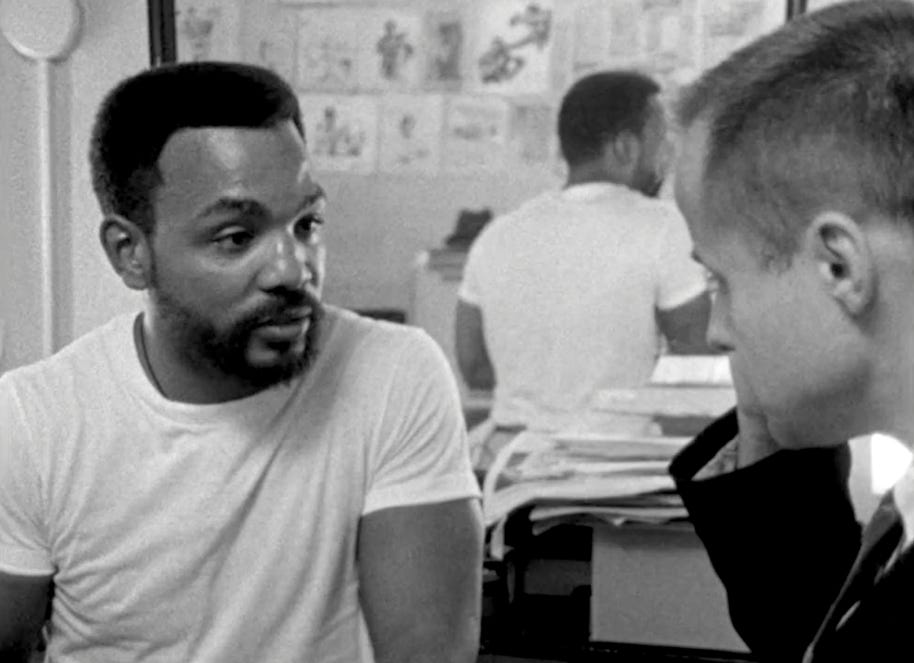
BJ: The funny thing is, the scene that I messed with the most in terms of altering reality was the barbershop sequence with Ernie and Bill. Bill was wonderful. He was really caring and thoughtful and bright and very intelligent. And everything Ernie said, Bill would either say “Yes, I understand, and that’s right, and it should be that way.” He always had a positive response, he always was affirmative toward what Ernie was saying.
I took it all out. In the film I just keep Bill silent and let Ernie do all the talking, because that got the capital “t” Truth across better than the literal truth. Bill would have been within his rights to complain, but he didn’t. He understood why I did that and how it served the film.
TKN: Wow. I don’t know if I would have that kind of humility, or integrity. Did you get any pushback from the African-American community?
BJ: No, no, no. None. On the contrary. I am never there to expose anybody except that part of them that is authentic to them. If you’re a racist, yes, I will try to show the world your racism. But that’s easy with racists, because they are authentically racist.

THIS LITTLE LIGHT OF MINE
From “Truth or Consequences” again:
TKN: So despite how bad things are at the moment, do you see any progress—culturally and socially—in terms of race from ‘65 to the present?
BJ: I feel there’s been a regression. But I am an eternal optimist only because I think that’s the best way to function in the world. Not because I honestly think things will inevitably get better—I’m not that kind of progressive. I do think that if Hillary had been elected the assholes would have felt justified in their hatred and they would have gotten worse, and it would have been more covert and therefore scarier in some ways. I mean, look at what they said when Obama got elected: they said our goal is to get him out. That was their main goal! Now, with Trump, they’re emboldened, which is bad, but to have them working beneath the radar would have maybe been more dangerous.
If we’re lucky it’ll be like a fever breaking.
TKN: So how does the church—to be sort of broad about it, but especially evangelicals who have completely betrayed all those things you just said in embracing a figure like Trump—how do they come back from that? Or is this a breaking point for evangelicalism?
BJ: If what evangelicals believe Jesus taught is not what Jesus taught, I don’t know how you get out of it.
Beliefs are obviously so much more powerful than facts. But to me that’s what you have to do if you’re going to be the best possible human—I won’t even say good, but the best possible human you can be—given all the garbage that you grew up in, all the bull you laid on yourself. The only way to do that is if you’re willing to begin again. As Rilke said, “If the angel deigns to come, it will be because you have convinced him, not by tears, but by your humble resolve to be always beginning: to be a beginner.” Every day I say that to myself.
TKN: But here’s the question. Are a significant number of those people gonna get to a point where they say, “Oh shit, we got suckered.” Or do they double down? Because right now there’s a lot of evidence that they’re doubling down.
BJ: Oh yes. I think the believers will double down. It’s the only choice they have. Are you kidding? To admit that their assertively held belief is a lie? Oh, that’s asking a lot. They built their whole lives around that.
TKN: But you’re the hope, Bill, because you broke out of it! You saw through it.
BJ: I was helped to break out of it and that’s why I believe strongly in continuing to make films and being involved with crazy people like you doing blogs because I think that’s all we can do. Lighting a candle is better than cursing the darkness. And lighting enough candles brings so much light that those people can’t hide anymore, and that’s my hope. And also I’m not responsible for the fricking world, thank you Jesus. I’m only responsible for me. So I’m just gonna spend my life trying to light little candles.
That’s the kind of risk I think we have to take. We have to take the risk of exposing the tragedy that is the political mood today.
THE WORLD AS WE SEE IT
TKN: So you were able to recognize the irrationality in fundamentalism, but so many people don’t. Why do people stay in a completely irrational belief system?
BJ: Oh, they would say that we don’t understand, we don’t know why God allows these things. Why does God allow earthquakes? Well, we don’t know that. And God created us for free will; that’s why people are terrible, not because God was a bad designer of human beings.
TKN: I’ve always contended that there’s some comfort in this idea of a god, even a malevolent god.
BJ: I don’t know about that, but yes, it is comforting. That’s why I say if you take care of the universe, the universe will take care of you. And there’s a sense in which I think that is true. I’m amazed at the good things that have happened to me in my life, inexplicably.
TKN: It’s karma, right?
BJ: Well, I don’t know, but I do think it’s something, I really do. I don’t even care to label it, but there’s something about paying attention to what’s possible instead of paying attention to what doesn’t work. And the thing is, what we don’t know is our capacity to infect others through our ideas. It’s not a matter of convincing others. I’m not big on convincing. My films are never logical arguments. I think that for a believer logic bears no relation. But I do believe that that truth can be infectious, and my only hope is that I may infect somebody. My nicest example to date is Henry Hampton, who wrote me a note when Eyes on the Prize got its first big award. He said, “Bill, I just wanted you to know that it was your film A Time for Burning that got me to believe that I could do honest films.” Who knew?
And that’s not why I did it, but that’s what happens. And that’s my only hope, is that we can infect one another with confidence. We can make a difference, and we can take actions that make a difference. And they make a difference not because we set out to make a difference, but because we set out to be authentic in our response to the world as we see it.
************
Photos:
BJ in a 2022 interview. Credit: Ficus Bon Vivant.
“Passing Storm” by Bill Jersey
Ernie Chambers and Rev. Bill Youngdahl in A Time for Burning (1966)
Namasta.